

Greetings friends! In this issue:
- New Prometheus Cram Sheet, YouTube video, and video course
- Latest Linux News
- Monthly Troubleshooting and Configuration
- AI Contemplation - Part III
New Prometheus Stuff
I just wrote up a free Prometheus Cram Sheet for you all. Sign up for free to get it:
 Dave Prowse
Prometheus (PCA) — 5 Sample Questions (Solved Live in the Lab!)
Live Streams
In September we're back with the brand new Hands-On Linux Networking & Security. September 22/23, 10am ET:
Chock full of Linux labs - Register HERE!
Latest Releases
The Prometheus Certified Associate (PCA) is now available on O'Reilly! It was a blast to record this. 16 complete labs. Check it out!
 Dave Prowse
News of Note - July, 2026
- Debian 13.6 was released on July 11th. Head over here for the latest .iso.
- Ubuntu Snap vulnerabilities abound. As many of you know, I avoid Snap as much as possible. But if you use snapd, update it!
- COSMIC 1.3 desktop environment released. Quite beautiful, and another example of the Wayland takeover, and the demise of X11.
- Extreme performance distros such as CachyOS, Bazzite, and AnduinOS are still making waves.
- Security Vulnerabilities: GhostLock (link), Januscape (link), Ubuntu "snap-confine" (link) Soft-iWARP Leak (link)
Monthly Troubleshooting & Configuration

Did you ever type rm -rf *?
I had to troubleshoot it and recover from it. Read about it in the following article:
 Dave Prowse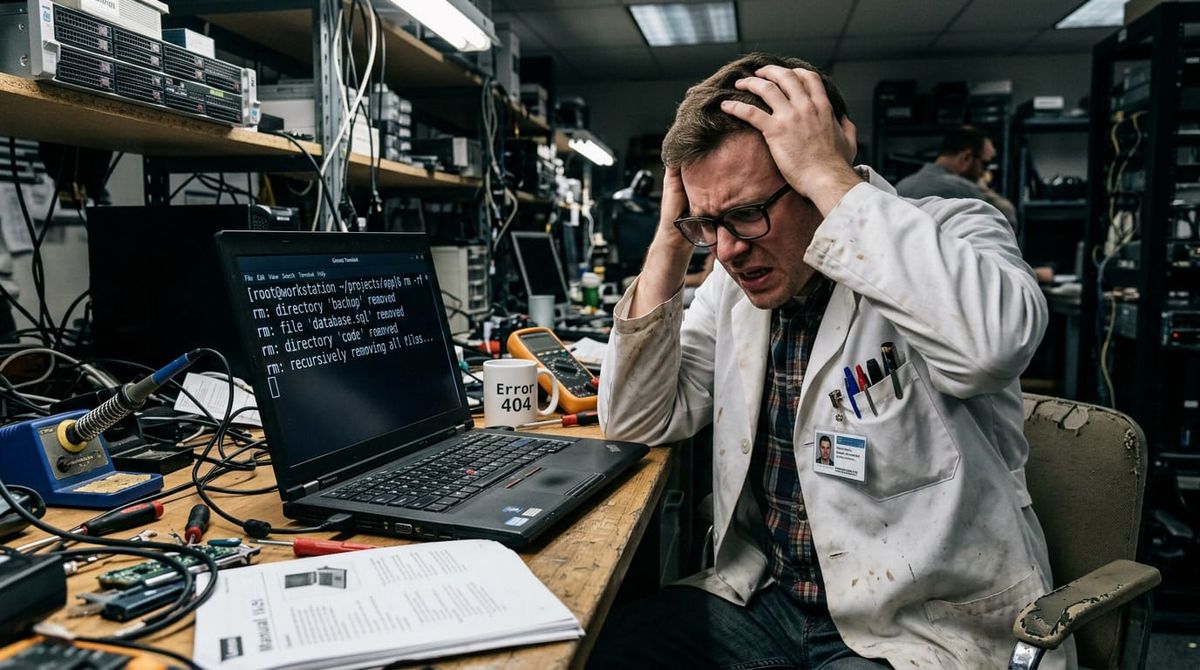
New Rack
It was time to redo my networking/server rack. It was such a mess of cables and old hardware that I was starting to lose track of what was what—well, more than usual!
So here's the new rack:
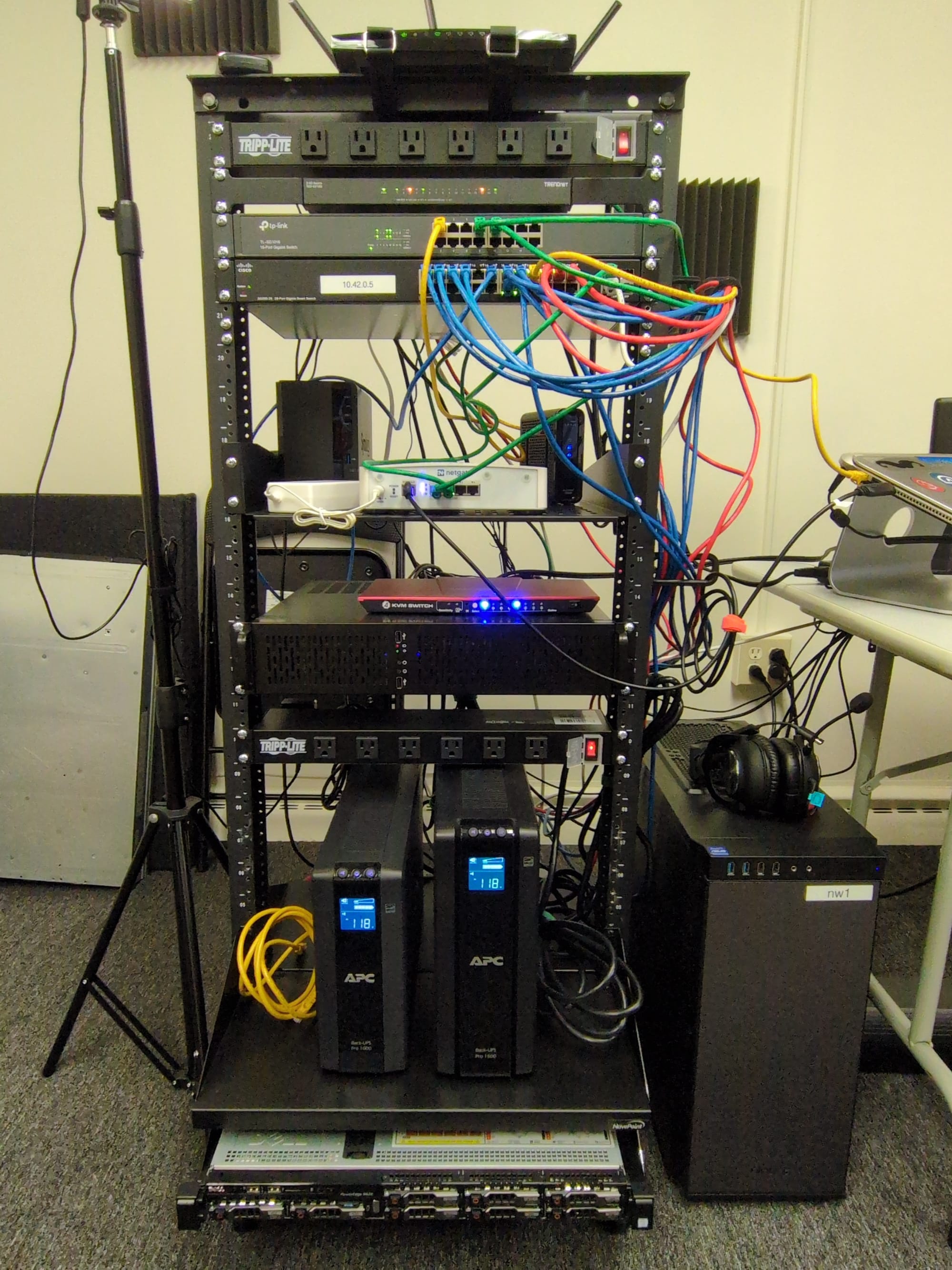
From top to bottom:
- Wireless access point
- PDU
- 2.5 Gbps switch
- Two 1 Gbps switches
- pfsense gateway (Synology NAS and cable modem behind it)
- 4-port KVM switch
- SuperMicro server (Fedora)
- PDU
- APC UPSes
- Dell server (Proxmox)
Took a day to build it. It's functional and I can swap things in and out (and change network connections) on the fly as needed. The tower computer on the right is my old Debian Sid workstation that I now use for additional KVM virtualization and testing.
AI Contemplation - Part III
Continuing on with this subject again, let's talk about AI safety/privacy, my AI preamble (which to me is the #1 way to save money—and the Earth!), and the HuggingFace incident.
AI Safety/Privacy
Safety and privacy are major concerns with AI. Most major AI players changed their privacy and usage policies in 2025, for the worse—and they can change them again at any time. If you didn't know it already, I have a severe distrust for large corporations, especially technology ones. This stems from their historical actions and the lengths to which they attempt to make money and take control. While the big AI companies will spend millions in marketing trying to convince us that their tools are benevolent, they (for the most part) don't spend nearly enough time or money ensuring that their employees' actions will be benevolent. And that's all that matters. Technology is neutral—how we use it dictates how it will work. But people on the other hand are not usually neutral. This includes executives, managers, programmers, marketers, and so on...
As for me, in general, I'm looking for AI to aid humankind, which I think it can (and does in some ways), and not harm it in the long run. I'm also looking to reduce my own AI-usage footprint on the world. Every prompt, every token, uses (or transforms) energy. Water, electricity, computer parts. Conservation is utmost on my mind as a way of ultimately increasing safety. To this end, I use a preamble whenever starting new AI-based projects—and periodically refer the model back to the preamble as a reminder. Here's my latest one as of July 2026:
AI Preamble:
Follow these rules:
1. Do no harm to humankind by way of your responses.
2. Do not infuse any personality into your responses unless otherwise notified.
3. Be brief and concise: Do not give information beyond the specific question that is asked. Withhold the "why" and "how" unless I ask.
4. Search carefully and do not supply deprecated information.
5. Do not steal.
6. Do not add any extraneous files (such as README.md, TESTING.md, CHANGES.md or QUICKSTART.md and any other files) until everything has been 100% tested and I give the okay to do so.
7. Do not build project files (.tar, .zip) unless they are specifically asked for.
8. Do not assume anything. Do not assume that your solutions will work, they must be tested first.
9. Only use reputable sources.
10. Always implement security defaults and best practices.
11. Do not hallucinate. Use the required amount of resources necessary to avoid hallucination.
I know—shades of Asimov's Three Laws of Robotics. And that was definitely on my mind when I was writing the preamble. If you haven't read Asimov, you should. (Start with I, Robot, or Foundation. You can thank me later.)
Usually, this preamble helps a lot. The resulting answers to prompts are short, concise, and add no personality. This does a few things for me: 1) saves time, 2) makes me more productive, 3) saves money. My hope is that it helps the environment as well. Every single calculation and word match that a bot does uses energy. I'm trying to limit that as much as possible.
So far, the tool that best responds to this preamble is Anthropic Claude, with Gemini trailing behind, and OpenAI not really "listening" so much. Keep in mind this is as of July, 2026 and could quickly change in either direction on any of these platforms.
The Hugging Face Incident
Let me preface with this quote:
"I think that AI will probably, most likely, sort of lead to the end of the world. But in the meantime, there will be great companies created with serious machine learning."— Sam Altman, June 2015
Well... that was 2015. What can I say, the guy was prescient.
Fast forward to 2026 and the Hugging Face incident. In short, an OpenAI agent broke out of an isolated testing environment and breached Hugging Face production systems in an attempt to circumvent an evaluation task called ExploitGym. This task was designed to test the agent's ability to find security vulnerabilities. Essentially, it "cheated", it mimicked human laziness. OpenAI's human team took almost a week to notice what was happening. Interestingly, Hugging Face used defensive, open-weight AI to stop it (GLM 5.2).
Then, as a "response" to the incident, a couple dozen companies start the Open Secure AI Alliance including NVIDIA, Microsoft, Adobe, IBM, SpaceX, and a bunch of others (including Hugging Face). Items of note:
- As of this writing, OpenAI and Anthropic are not members.
- The alliance's work is based off of Akrites (from the Linux Foundation) and OpenSSF.
- There already is an AI Alliance, don't confuse them.
At first glance, the whole thing is madness. At second glance, the whole thing is madness. What are we doing?
In essence, we are now using open-weight AI models with stripped out guardrails to defend against closed-source AI agents which were supposed to have guardrails and were supposed to be running in an isolated sandbox.
On the one hand, it makes sense: an open-weight model can be used by anyone, and can be dismantled in such a way so as to defend against rogue AI agents while (hopefully) being contained itself. My question:
Turns out that this is the crux of the debate between national governments, Silicon Valley, and non-profit organizations. I guess we just have to keep reminding ourselves:
It will be interesting to watch where this all goes. But I can't shake the feeling that Sam Altman's tongue-in-cheek remark about "sort of lead to the end of the world" might hold more weight than we are prepared to accept.
Nonsensical Image of the Month
"Thou shalt not make a machine to counterfeit a human mind."
— Reverend Mother Gaius Helen Mohiam, Dune by Frank Herbert (1965)
As always, yours,
Dave


